
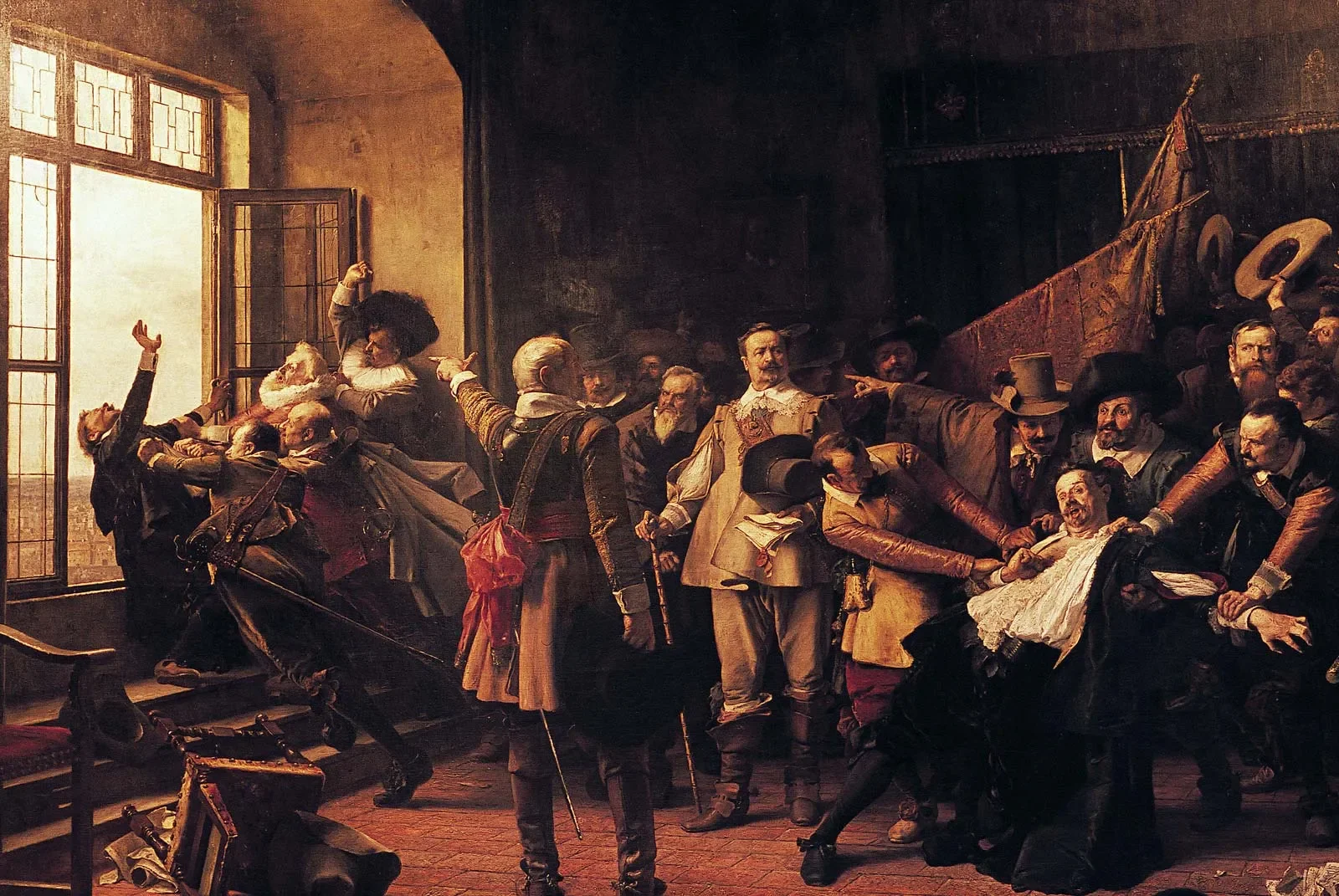
A Window of Opportunity: The Defenestration of Prague, 1618
APPROXIMATE COMMITTEE SIZE: 30 delegates
In the early 16th and 17th centuries, the Catholic Habsburgs ruled over Bohemia, a state made up of majority Protestants. The Habsburgs have historically allowed Protestants to practice their religion, and recently permitted them limited rights to land and legal authority, but Bohemian Protestants feared that the staunchly Catholic heir apparent, Ferdinand of Styria, would end that regime of tolerance. The Protestant Reformation of the 1500s gave rise to the Counter-Reformation, deepening religious divisions and increasing hostility between Protestants and Catholics across Europe. As Ferdinand’s ascension approached, Protestant leaders increasingly organized through legal appeals and political assemblies to defend their religious rights, a confrontation that ultimately culminated in the defenestration of two Catholic royal officials from a Prague window. Delegates will be tasked with resolving these escalating tensions while determining the future balance of political and religious authority within the region.
Crisis Manager: Yu Fan mei
CHAIR: JACK BIEMER
ISSUES TO CONSIDER
Issue 1: Authority and Response to Defenestration: Following the Defenestration of Prague, Bohemian nobles have openly defied imperial authority, creating a power vacuum and increasing the risk of retaliation from the Holy Roman Empire. How should delegates respond to this act of rebellion? Should they attempt to de-escalate tensions with the Emperor or consolidate control within Bohemia and prepare for conflict?
Issue 2: Religious Authority: While the majority of Bohemia throughout this period practiced Protestantism, government authority was influenced by the Catholic Church’s Counter-Reformation against Protestants. The conflict between religious authority and government influence led to the defenestration but continues to be a major issue threatening the region. How will religious tolerance and authority influence the structure of society moving forward? Can religious authority and state authority be reconciled?
Issue 3: International Cooperation: The role of the Catholic and Protestant church leadership and officials throughout Europe was very influential on domestic policy and foreign relations with other empires. In what ways can international relationships be cultivated despite current religious rifts?

About the Chair
John (Jack) Biemer is a student at the Georgetown University College of Arts &Sciences class of 2028. He is majoring in History and Government. He was born and raised in the Chicago area. At Georgetown, he participates in the Model United Nations team, the DC Schools Project, and the Georgetown Journal of History. Outside of school, he is usually catching up on his reading list, practicing his Spanish on Duolingo, or working out in the gym. He is honored to begin his work with the Georgetown International Research Group and the Action on Armed Violence in particular.

About The Crisis Manager
Yu Fan Mei is a member of the class of 2027 majoring in mathematics and minoring in public health and computer science. He is from the Boston area and has been heavily involved in model UN, last serving as International Relations Club’s Director of Human Resources, Diversity, Equity, and Inclusion until May 2026. Last year, Yu Fan was NAIMUN’s grand crisis manager for The Elephant and the Whale. Outside of MUN, he is involved in No Pressure Creatives musical theater, a student advisory board member for the First Fellows program, and a member of Rangila and BEACON Health Education. Yu Fan is super excited to serve as the crisis manager for A Window of Opportunity and to welcome you to NAIMUN LXIV!