
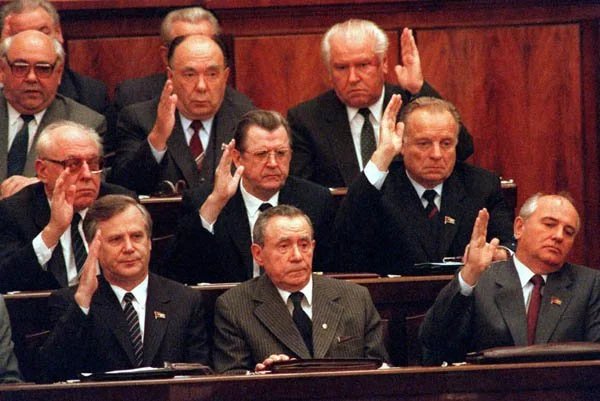
The Elephant in the Room: Soviet Politburo, 1986
Approximate Committee Size: 30 Delegates
At 1:23 AM on April 26, 1986, Reactor No. 4 at the Chernobyl Nuclear Power Plant in Soviet Ukraine exploded during a routine safety test, triggering the worst nuclear disaster in human history. The initial blast and subsequent fires released an estimated 14 EBq of radioactive material, contaminating vast swaths of Europe. In the hours that followed, plant workers and firefighters, unaware of the true nature of what they were fighting, absorbed lethal doses of radiation. Local officials reported a fire, not a meltdown. The reactor, they insisted, was intact.
Founded on principles of state control, information management, and ideological preservation, the Soviet system was ill-equipped to respond to a catastrophe of this magnitude. The Communist Party of the Soviet Union, led by General Secretary Mikhail Gorbachev, had only recently begun its tentative experiment with glasnost. As reports from Chernobyl grew increasingly alarming throughout April 26th, the Politburo faced a crisis that threatened not only public health but the credibility of Soviet nuclear technology, the legitimacy of the Soviet state, and the USSR’s standing on the world stage.
This committee places delegates inside the Kremlin in the aftermath of the explosion as the Politburo convenes for an emergency session with incomplete information, competing institutional loyalties, and enormous political stakes. Delegates will portray the members of the 1986 Politburo, each bringing their own ministry’s interests, ideological commitments, and personal relationships with Gorbachev to bear. They must decide how much they know, how much they are willing to admit, and what the Soviet state owes to its own people, to neighboring nations in the path of the fallout, and to an international community that is only beginning to ask questions.
CHAIR: olivia fanders
Crisis Manager: ruby adler
ISSUES TO CONSIDER
Issue 1: Information Control and State Transparency: In the first hours after the explosion, Soviet officials at every level suppressed and distorted reporting on the disaster’s true scale. How should the Politburo manage the flow of information domestically and internationally? At what point does concealment become untenable, and what are the consequences of delayed disclosure?
Issue 2: Crisis Response and Evacuation: Tens of thousands of civilians in Pripyat and surrounding areas remain unaware of the radiation exposure they are accumulating. A full evacuation would signal the severity of the disaster and invite scrutiny, while a delay risks mass casualties. How should the Politburo weigh the political costs of transparency against its obligations to Soviet citizens, and who bears responsibility for the decisions made in this critical time?
Issue 3: Accountability and the Integrity of the Soviet Nuclear Program: The Chernobyl disaster exposed deep systemic failures in Soviet reactor design, safety culture, and institutional oversight. As the scope of the disaster becomes undeniable, the Politburo must determine how to assign blame, protect the broader legitimacy of the Soviet nuclear program, and respond to a growing international demand for answers, all without undermining the authority of the Party itself.
About the Chair

Olivia Fanders is a member of the Class of 2028 in the Walsh School of Foreign Service, studying International Politics with a minor in Journalism. Olivia grew up in Weehawken, NJ, where she founded her high school's model UN team and hosted two middle school conferences. This is Olivia's third NAIMUN as well. In her first year, she was a crisis analyst for the All-Women’s Historical Crisis Committee. Most recently, she was the Director of Registration at NAIMUN LXIII. She is looking forward to creating a great experience for delegates this year. In her free time, Olivia loves to create random video journalism projects, write poetry, design new Notion pages, and wander through D.C.'s independent bookstores in search of her next favorite author.
About the Crisis manager

Ruby Adler is from sunny San Diego, California, and is super excited for NAIMUN LXIV! A member of the Class of 2029 in Georgetown’s School of Foreign Service, Ruby has been involved in Model UN since she was fourteen and even attended NAIMUN as a high school delegate. Outside of Model UN, Ruby is a member of Delta Phi Epsilon, a pre-professional foreign service sorority, and serves as Director of Marketing for Hoya Blue, Georgetown’s student section club (follow them on Instagram at @ibleedhoyablue). In her spare time, you can find her trying to complete as many D.C. side quests as possible or struggling to learn how to knit. Ruby is excited to meet everyone in February!