
JJ Dove, Press Corps 16
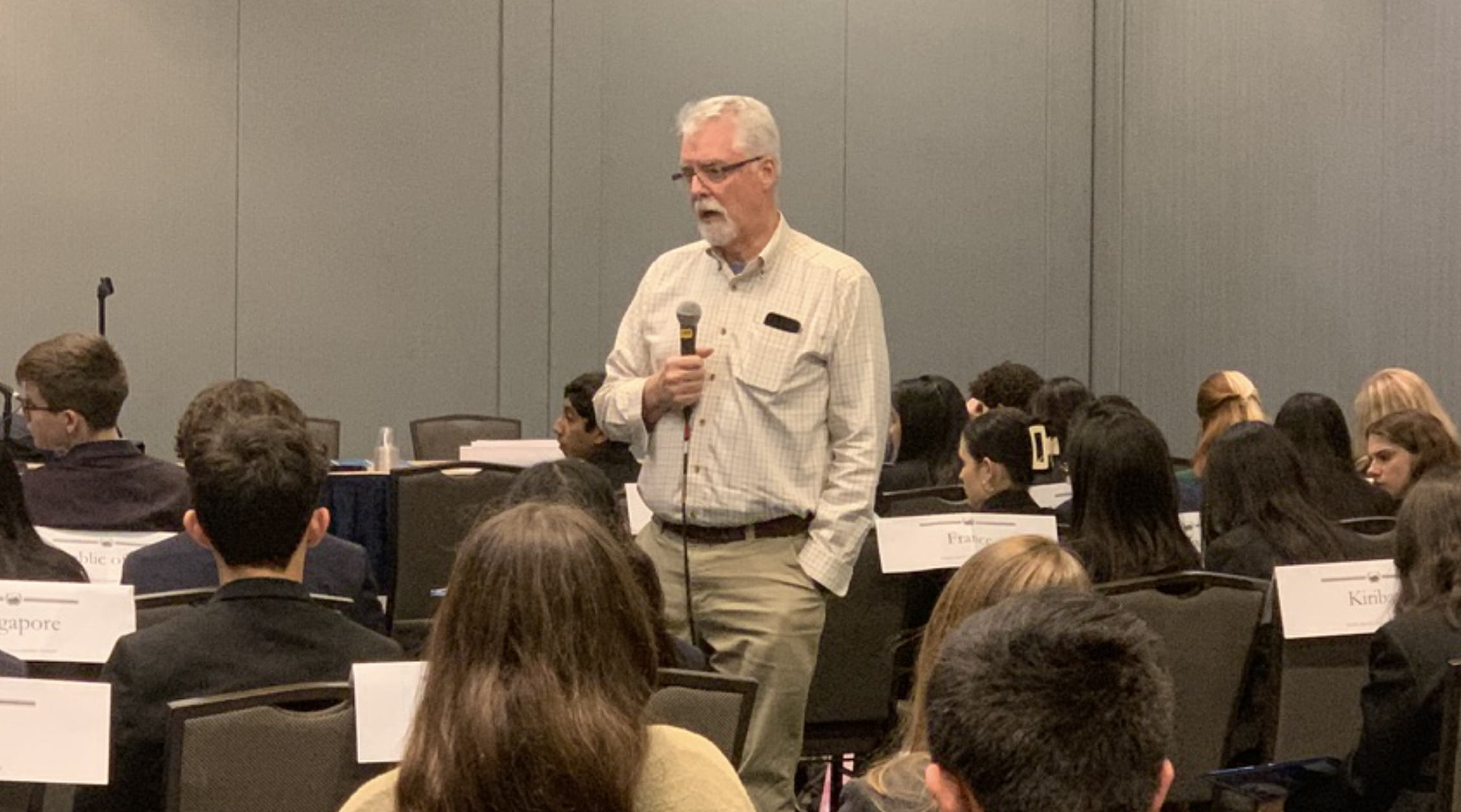
THE KOHIMARAMA CONFERENCE, Historical Crisis — As NAIMUN reconvened this Friday, Feb. 17, 2023, for Committee Session II, The Kohimarama Conference Committee hosted guest speaker Alan Tidwell, Director of the Center for Australian, New Zealand and Pacific Studies at Georgetown University.
Professor Tidwell’s work, centering Australian-American relations, includes published works “Land, Indigenous Peoples and Conflict” and “Conflict Resolved?”, a critical examination of conflict resolution which can be found within the Library of Congress. He has also been featured on “The Precision-Guided Project” podcast, where he offers an analysis of Oceanian geopolitics, and published several papers with various institutions in Sydney, Australia.
His expertise and personable, down-to-earth demeanor also earn him a perfect (5/5) rating on RateMyProfessors.com.
“I'm actually considering dropping out of Georgetown and moving to Australia after taking his proseminar. [...] I have never met a professor who is more accomplished or chill,” an anonymous student claimed as recently as Dec. 17, 2022.
Throughout his presentation, delegates in the “Kohimarama” committee, set in 1860 New Zealand, were encouraged to pose questions and propose solutions to the crisis.
In one such comment, Pehimana, Son of Nga Rauru Chief Aperahama Tami-i-parea, contemplated the implications of the Maōri people “legitimizing” themselves by establishing self-led institutions. He suggested that, had they done so, British colonizers may have approached conflict resolution with more respect and willingness to collaborate.
By raising the issue for Tidwell’s consideration, he sought to determine the merit of his proposal in the context of the committee, reinforcing or replotting his next steps in the historical crisis.
Tidwell considered Pehimana’s proposition an “interesting one,” citing Maōri internal conflict, specifically during the Musket Wars, as an obstruction for its occurrence. However, despite the historical impossibility of Maōri institutionalization, he seriously considered the potential of this idealistic hypothetical in the committee’s simulated context.
“That would be a really powerful movement,movement”, said Tidwell. In his eyes, the tribes uniting and institutionalizing in this way could very likely have changed the outcome of the Kohimarama Conference. Effecting Maōri institutionalization in their committee could bring the delegates closer to the peaceful resolution their chairs desire.
It’s this ability of Tidwell’s, to wed his extensive knowledge of Australian history with critical analysis of its “how”s and “why”s, that has made his perspective so impactful to the committee.
Pehimana stated, “He affirmed my ideas for the institutions.”
“He clarified and told us about the roots of the problem,” wrote Tamati Waka Nene to NAIMUN Daily.
Identifying the causes of the crisis in this way has allowed delegates to create and refine possible solutions with more clarity. Though they have independently conducted research on the topic, Tidwell’s more intensive knowledge and capacity to dynamically apply it to the simulation offers a more holistic perspective on the issue.
Tidwell’s contributions to the “Kohimarama” delegates reinforce the importance of intelligent discussion rooted in mutual respect. NAIMUN 60’s theme, Empathy in Action, takes center stage in this intersection of information and cooperation, where negotiation and conflict resolution can thrive.