Aashna Miharia, Press Corps 11
WHO, General Assemblies — In the first hours of Feb. 6, 2023, a natural disaster forever altered the lives of millions in Turkey and Syria. The 7.8 magnitude earthquake that hit horrified these nations and the world as the death toll rose with each passing hour.
Many of the subsequent issues, including the effect of cheaply-built housing and a lack of access to medical care, are currently magnified in the media regarding the people of Turkey and Syria. However, nations worldwide also face similar daily struggles, mainly due to the rapidly-growing urbanization rates.
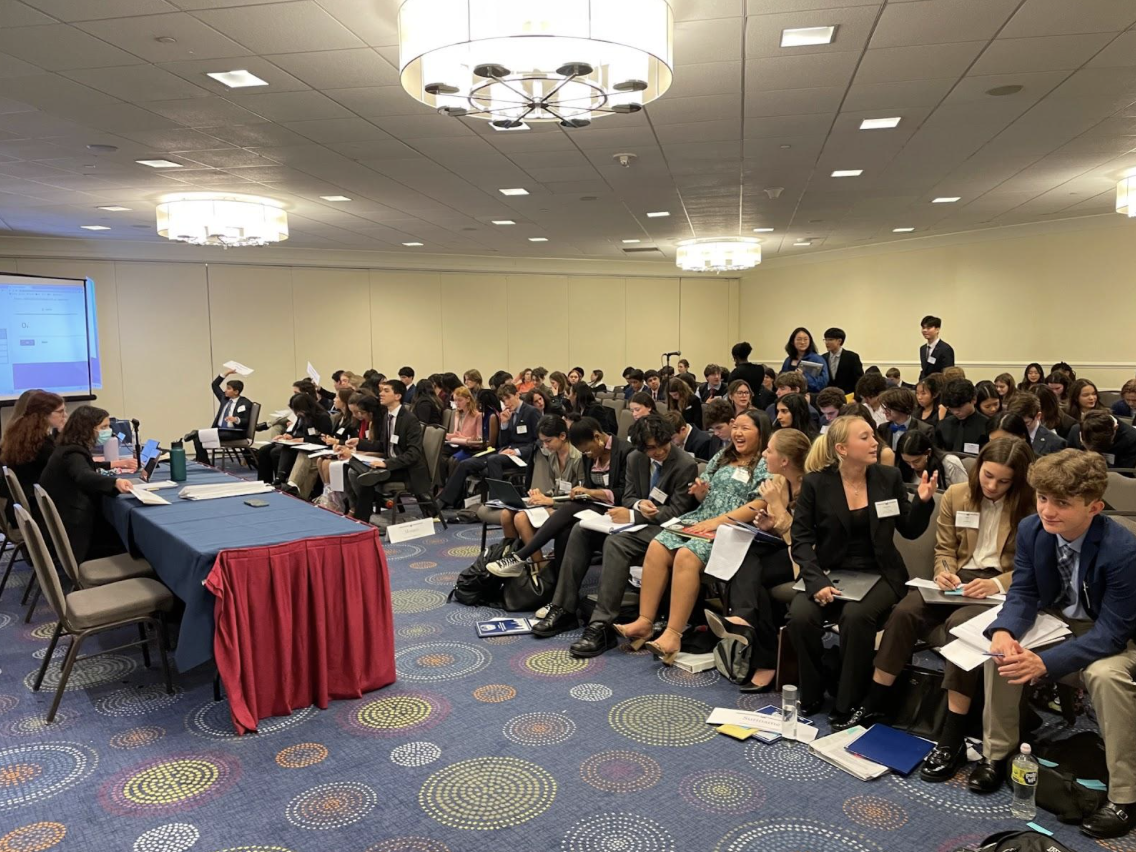
From Feb. 16 to 19, the delegates of the World Health Organization are striving to craft practical solutions to the multi-faceted issue in the cross-section of poverty and health that rapid urbanization creates.
“I'm really hoping that our delegates come up with some solutions that address the inequities in health care and resource access around the world,” Lauren Tomiko, this committee's chair and a Georgetown junior studying Science, Technology, and International Affairs (STIA), said.
As of Friday morning, the delegates have congregated in four large blocs to write resolutions on their common goals.
“Accessibility to appropriate medical care is probably the most pressing issue,” the delegate representing the Republic of Senegal said to the NAIMUN Daily, speaking on behalf of fellow developing nations in Sub-Saharan Africa.
Their bloc, with nations such as Mozambique, Sweden, and Fiji, want to address the declining health conditions of urban populations, often largely populated with low-income people.
“Declining health due to urbanization is a very prevalent topic in a lot of countries because so many countries in the world are still developing,” Senegal continued. “So this [resolution] would really affect countries in every continent, and it's just something that needs to be addressed.”
The recent tragedy has compelled The Republic of Turkey's president to focus on improving infrastructure.
“We need to focus on the people in the cities such as Istanbul, which was affected by this earthquake as now they've lost their homes,” Turkey's representative delegate stated. “They don't have any money and they don't have food.”
The Principality of Monaco is working closely with Turkey this weekend. As a nation that sees sparse poverty within its walls, they are eager to help others in the UN.
“[Monaco wants to] try and send architects to these nations to help with [their] infrastructure,” Monaco said. “[They can] help out and help design low income buildings that can hold as [many] people as they can comfortably [hold] without causing spread of disease and other issues like that.”
Monaco and Turkey's final resolution aims to incentivize other developed nations to donate to a novel fund and implement a carbon tax among countries.
But that is not the whole story. Turkey believes another deeper issue accounts for the unmanageable magnitude of their current situation.
“Pollution is an issue that's impacting millions of people across the world. We're dealing with a crisis, as there's multiple people living in slums who are surrounded by waste,” said Turkey.
With that, The Republic of Turkey's bloc dedicates its committee time to improving sanitation and finding alternative uses for waste. For instance, utilizing pollution's biogas, Turkey plans to morph it into the very thing many lack: energy.
For months, the World Health Organization planned to discuss the complex causes and effects of urbanization and natural disasters, including infrastructure and sanitation, this weekend. To the untrained eye, it may seem merely well-timed due to the historical earthquake in Syria and Turkey a mere eleven days ago.
In reality, these issues weave through the quilts of lives, communities, and cultures. In the two more days of NAIMUN LX left, the delegates will continue collaborating to help improve the lives of millions dwelling in one Eurasian region and around the world.