
NSA JAPAN, Non-Traditionals — On February 18, 1946, five hundred soldiers perished in a naval ambush while docked in Java, Indonesia. However, one survivor’s testimony and an admission of guilt reveal that the soldiers were not killed at the hand of enemy battleships, but that of their very own leader. Last night, Japanese Army Minister and government official Sadamu Shimomura led an attack on his country’s naval fleets, citing his government’s lack of military action as justification for his treachery.
Sadamu’s symbol, a lightning bolt surrounded by the letters of his name, was found at approximately 10:56 P.M. painted on the buildings destroyed in the attack. An estimated twenty-six ships were lost, leaving behind only one confirmed survivor from the entire Japanese fleet in Java.
The ships that perpetrated the ambush have been identified as French navy battleships. A proud ally of France, Sadamu often references his control and authority over the French navy, which he uses to garner support for military action against Japan’s enemies.
“I’m the French military ataché, and close friends with the French president,” Sadamu told the NAIMUN Daily.
Despite Sadamu’s public admission of his French affiliations, the Japanese government remains largely unaware of his involvement in the attack. Sadamu is a prominent advocate for Japanese military intervention and emphasizes the importance of having an armed presence in Indonesian waters.
The surviving soldier remains the only witness to the ambush. The soldier, who requested that he be referred to as Soldier Li, spoke to the NAIMUN Daily about his recollection of the event.
“Last night, [Japanese ships] were stationed in Java. We were about to be evacuated to our home islands after serving a long tour in Indonesia,” stated Solder Li. “But these French forces attacked us without provocation and started burning down houses. We were just in shock because we didn’t know how to respond.”
He tells about the unnamed Japanese officers he witnessed aboard the French ships, who were assisting in their attack on his fellow soldiers. He also provided an illustration of Sadamu’s symbol, which he witnessed the Japanese officers painting on the hulls of targeted ships, along with other buildings destroyed within the port.
“Yeah, it seemed odd that these French forces would just attack us. I spotted a few Japanese officers on the ships, I’m not sure if they were behind this attack,” said Solder Li. “They were leaving these strange logos around that stated ‘Sadamu’.”
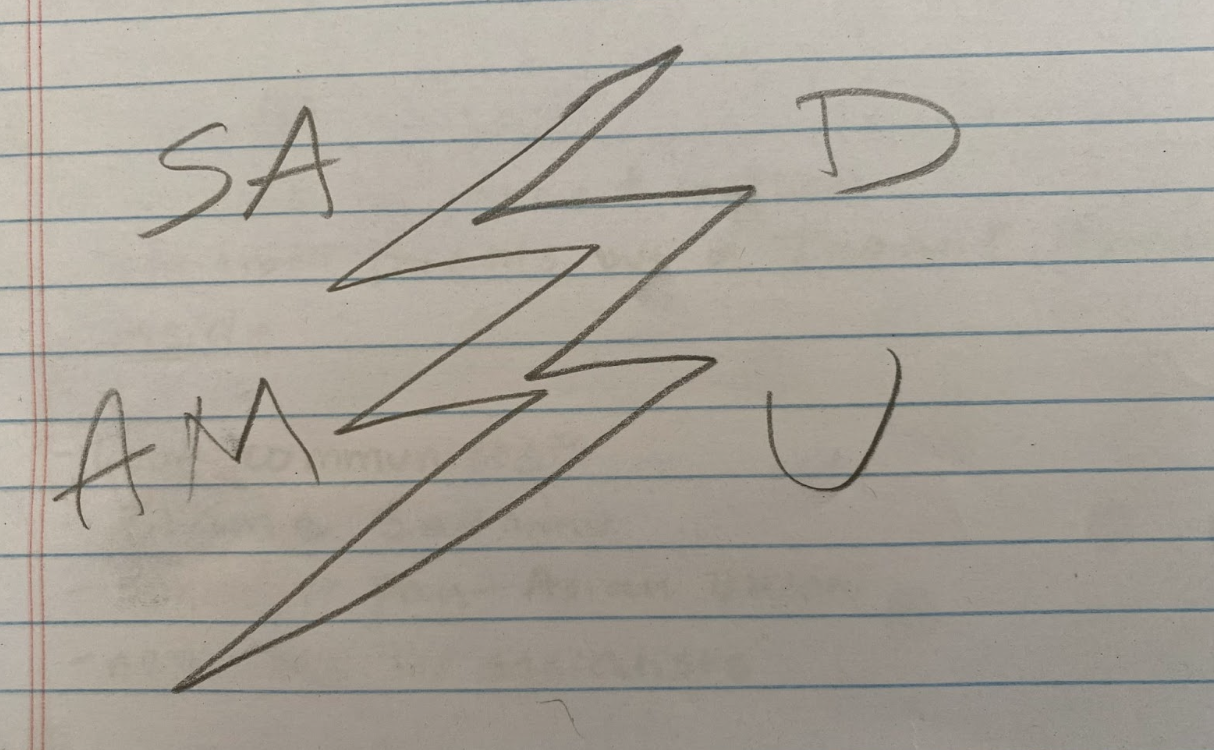
Soldier Li’s illustration of the Sadamu symbol he saw painted on destroyed buildings by dissenting Japanese officers.
Credit: Minji Bu, Delegate 10
An interview with Sadamu himself revealed the legitimacy of Soldier Li’s testament, unveiling the true motivations behind his ambush on the Japanese fleet.
“The committee was being too inactive and kept wanting to pull out our troops,” Sadamu stated. “I had to do something, so I took control of the French navy and knocked out the general with a good uppercut,” he said, demonstrating the motion with his arm. “Then, I took control of the entire French army.”
Sadamu’s betrayal spells disaster for the Japanese people’s faith in their provisional government. As a country still in recovery after the events of World War II, Sadamu’s treachery is the final nail in the coffin of Japan’s imminent demise. In a newly established government such as Japan’s, every member is a foundational pillar preventing the country’s collapse. Now, following Sadamu’s secession from Japan’s path to peace and prosperity, the remaining members of the government are tasked with prosecuting Sadamu for his crimes and stopping his betrayal from destroying the country’s future. They lie at the crossroad where opportunity and prospect diverge, leaving the world waiting with bated breath to witness the Land of the Rising Sun’s fate.