
Kevin Wang, Press Corp 6
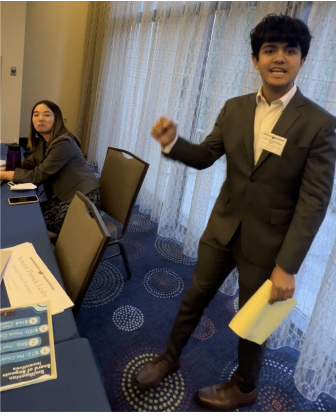
Senator Masto berates one of the protesting Georgetown students, leaving her in tears.
SMITHSONIAN BOARD OF REGENTS, Contemporary Crisis — On February 18, 2020, in bitter cold and shredding wind, a group of four Georgetown students chained themselves to the outside of the Museum of Natural History. These activists came to protest the failure of the Smithsonian to repatriate the over 2000 remains of indigenous people they’ve kept from their communities of origin.
The Smithsonian has a complex history with the repatriation of Native American remains. In 1989, the Smithsonian established the National Museum of the American Indian Act, which requires the Smithsonian to return, upon request, any Native American objects of cultural significance to their tribes of origin. However, of the 14,000 remains they’ve stored since 1987, there are still 2,000 remains that have yet to be returned.
The students at Georgetown stand firm in their commitment to protest the Smithsonian’s policy.
“We’re prepared to stay here as long as it takes before the Board of Regents makes the correct decision,” Ted Weezer, a sophomore at Georgetown studying peace studies, said. “However long that takes is however long we’ll stay.”
These recent developments have polarized the Smithsonian.
The majority are in favor of repatriation, but a vocal minority question the necessity of it. Three members of the Board—Senator Masto, Senator Boozman, and Barbara Barrett—don’t think repatriation is necessary and even called for the expulsion of the protesting students.
“We can't be bullied by a bunch of random students,” Senator Masto proclaimed in a passionate fervor. “We must get their administration to expel them immediately. We’re just telling them to move, and maybe to go to class a little bit, which is what they should be doing in the first place.”
The rest of the group, mostly led by a directive known as “Lovely Loans: 2 L’s Make a W,” have condemned Senator Masto’s treatment of the Georgetown students in this manner.
“[Senator Masto’s] behavior is no less than childish”, said Congresswoman Roybal-Allard. “Whereas the students are acting so much more like adults by utilizing their first-amendment rights.”
In fact, the majority of the group believes that repatriation must happen as soon as possible. Congresswoman Roybal-Allard remarks, “it’s necessary for families to feel solace that they have their loved ones back”
Fundamentally, the disagreement between the two groups is about the bureaucracy inherent to the process of repatriation.
“It seems like they’ve created so many unnecessary hurdles that it makes me wonder if they really want to repatriate the objects at all,” said Weezer.
In contrast, Senator Masto said, “I think repatriating the remains is something we should do extremely carefully. Right now, it sure does seem that these processes were put in place for a reason: to avoid fraud and incorrect repatriation.”
The Georgetown students’ protest has brought to light the underlying tension in the Smithsonian’s stance on repatriation. The question of resolution lingers in the air. The brave, young students of Georgetown against the crushing, ancient bureaucracy of the Smithsonian. The times are changing, and it’s time for the Smithsonian to change with them.