Aurora Lai, Press Corps 2
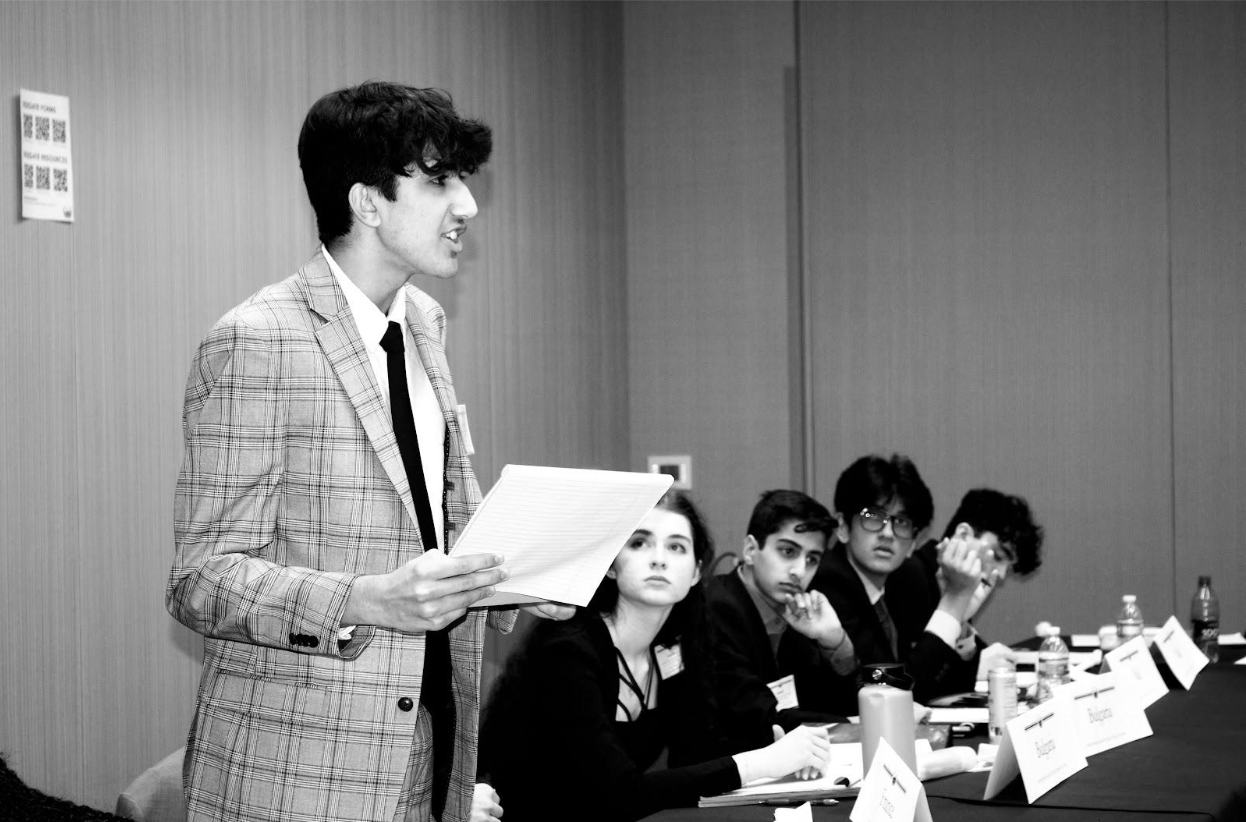
The delegate of France asserted in the first moderated caucus that “we need to make change permanent,” echoing the mission of the UNSC (Aurora Lai).
The delegate of France asserted in the first moderated caucus that “we need to make change permanent,” echoing the mission of the UNSC (Aurora Lai).
UNSC, Historical Crisis — On the morning of February 19th, 1966, the United Nations Security Council gathered as shattering news of an invasion shocked the committee as soon as delegates settled into their seats. Between compromising with delegations and pushing their nation’s independent agenda, the delegates unified to find timely solutions to the Republic of Congo’s invasion of one third of the Democratic Republic of the Congo (DRC).
Meanwhile, anonymous sources from the Associated Press reveal that the USSR may be involved. Though, this rumor didn’t hold the spotlight for long, especially not when the directives “Aid Plan” and “REMP” (Reallocating Establish Military for Peace) passed. As debates resumed post-crisis, now with a focus on protection and prevention for the DRC, five directives emerged, yet only two passed. Of the two, the NAIMUN Daily had the opportunity to sit down with delegates of the “Aid Plan,” which was an extension of the directive “CareBear,” which passed last night.
“Under ‘CareBear,’ it was a care package for social and humanitarian aid for those dealing with the aftermath of protests,” the delegate from Nigeria explained, as they worked alongside Uganda and Uruguay. “Now, through ‘Aid Plan,’ social workers civilians throughout the country have been incorporated to distribute resources, such as feminine products.”
Beyond allocating resources, “CareBear/Aid Plan” aims to reverse the trend of the staggering death toll from the Congo Crisis between 1960 and 1966— totalling nearly 100,000 deaths thus far—with hopes of stationing troops along the region of the DRC that was invaded to combat future warfare.
The future prospects of “CareBear/Aid Plan” have come to the forefront of this committee’s attention with a successful vote of 12-2, leaving little room in debates for any speculation over the USSR’s potential involvement in the invasion. Despite the unity over the passage of this legislation, solving the crisis in war-ridden Congo is muddled with the delegates’ very own “war of words” between themselves and their ideologies. When the NAIMUN Daily requested comments, several nations had their own say.
“We’ve been trying to figure out how to push the allegations elsewhere because we know it’s not us,” the USSR delegates stated. “We suspect that there’s someone pretending to be us, specifically Uruguay.”
While delegates from Uganda, Bulgaria, and New Zealand share the common sentiment that the invasion is likely not correlated to the USSR, some delegations still have suspicions, with New Zealand believing that the USSR might’ve funded the invasion.
“We believe that as an African nation, we are advocating to protect the Congolese people whereas the foreign powers are trying to extract resources. We should push the USSR and other world powers out,” the delegation of Mali, one of three African nations, expressed. “We are our own people.”
As questions remain unanswered and new crises beckon new solutions, the status of the USSR remains uncertain. Yet the definitive nature of directives like ‘CareBear’ brings the hope that this committee seeks to achieve.