
Olivia Metelo, Press Corps 18
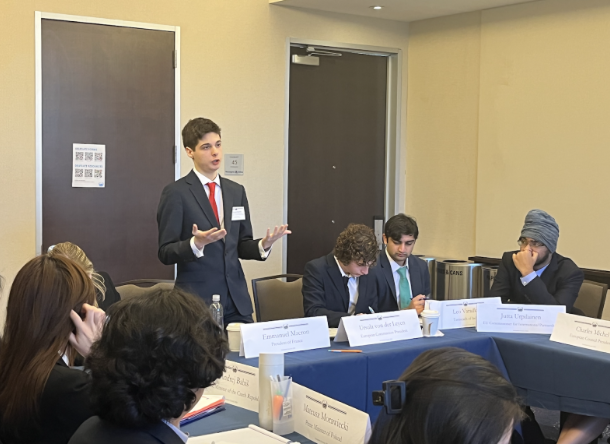
EUROPEAN COUNCIL, Contemporary Crisis — Economic crisis was anything but scarce within the European Council today, and members are divided on how to best address those responsible. How the council responds has the potential to prevent future financial crises in Europe, council members tell the NAIMUN Daily.
Angela Merkel, chancellor of Germany, pulled all of her country’s funding from the European Union as a form of protest against the lack of action to combat democratic backsliding in Hungary and Poland. These nations face notable issues such as violence against LGBTQ+ people, racism, and discrimination against immigrants, all of which Merkel believes calls for more attention from the council.
“It is extremely frustrating that it is something that is not being talked about because it should be our most important value,” said Merkel. “These are the lives of our people and the people that live in the countries that we support.”
The pulling of Germany’s funds caused the European Union to enter a financial crisis, something certain council members found to be concerning.
“The fact that the European Union's budget was based very largely upon one nation's economy is not a good idea because if an event something like this happens again, the rug is pulled out from underneath us,” said Dubravka Suica, vice president of the European Commission. “We need to start developing other solutions so that an economic crisis like this one won't happen again.”
Many were frustrated with Merkel’s decision to pull Germany’s funds, especially regarding her lack of communication with the council.
“They should have told us that they were going to start an economic crisis by taking out all of their money,” said Jutta Urpilainen, european commissioner for international partnerships. “I thought that was incredibly short-sighted.”
Directives were presented in an attempt to punish and condemn Merkel for her actions, though none were able to successfully do so. In response, Suica co-sponsored the “Three Steps Back Plan” directive, which aimed to prevent Germany from being condemned or punished, start EU-based investigations into how European nations were impacted by the financial crisis, and create domestic economic improvements.
Suica maintained that punishing or condemning Germany would have negative ramifications.
“We want to help the European people. Germany is a European Union member state and I think isolating [...] Germany like that is a bad decision,” said Suica. “I've talked to the Chancellor of Germany, and they said they would be opening to bring in funding back eventually if we keep relations open and fair with them.”
Only the latter two clauses of the directive were passed, as many members were still divided on whether or not Merkel deserved condemnation. Merkel’s role within the directives was surprising, however.
“I wrote some of those directives to condemn myself because I agree that I definitely should be condemned,” said Merkel.
In a similar fashion, Christine Lagarde, president of the European Central Bank, later pulled funds from Poland, Hungary, and Slovenia.
“We found out through an audit that they were misappropriating funds for personal use and participating in insider trading,” explained Lagarde.
Urpilainen was again frustrated and questioned Lagarde’s motives.
“Do what’s best for our political interests and not your political pawns,” stated Urpilainen.
Still, Lagarde defended her decision, arguing that pulling funds from these nations would result in their eventual compliance with the council’s expectations.
“We need to hold these leaders accountable,” said Lagarde.
Regardless, the council members were diligently working to alleviate the financial crises.
“Honestly, financial crises always have been very small,” said Urpilainen. “But the problem with this is it came into the public and got entirely out of control, and now we are trying to work to solve it.”